
Jump to a section
Introduction
TL;DR
Yes — you can get paid to write reviews through programs like Amazon Vine, Slice the Pie, BrandBacker, and freelance content platforms. But writing fake platform reviews for cash is a direct FTC violation with fines up to $50,000 per review. This guide covers what actually pays, what's legal, and where the line is.
"Can I get paid to write reviews?" is one of the most searched side hustle questions of 2026 — and for good reason. Reviews drive purchasing decisions, local rankings, and brand trust. Businesses need them badly, which has created a real (and sometimes murky) economy around review writing.
The answer is yes — but the path you take determines whether you're building a legitimate income stream or walking into a legal minefield. This guide breaks down every legitimate option, exactly what each pays, and the one category of "paid reviews" that will get you — and the businesses that hire you — in serious trouble.
If you're a business owner trying to understand why your competitors have so many reviews, start with our guide on the full review acquisition landscape in 2026.
Legitimate Paid Review Programs
The most established way to earn by writing reviews is through brand-authorized programs. These are legal, FTC-compliant (when disclosed properly), and do pay — though the definition of "pay" varies.
Amazon Vine
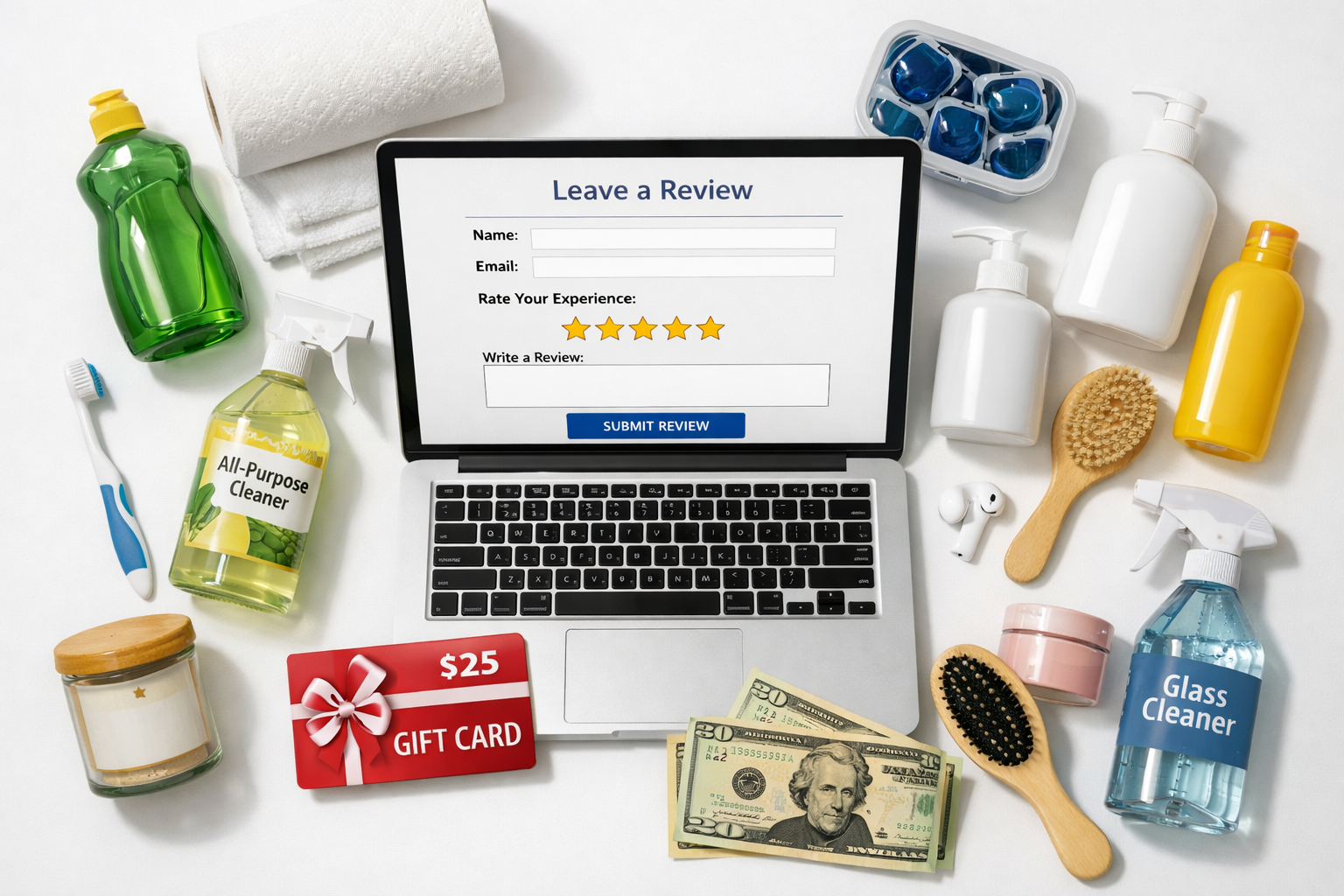
Amazon Vine is Amazon's invite-only reviewer program. Top reviewers on the platform are selected by Amazon's algorithm and given free products to review — no cash, but the products are yours to keep, valued anywhere from $5 to $500+. As of 2024, items valued above $600 are considered taxable income in the US.
- Pay: Free products (taxable above $600)
- How to qualify: Build a strong organic review history on Amazon — no shortcuts
- Volume: Top Vine Voices receive 1–5 products per month
For a deeper breakdown of how Amazon's reviewer programs work, The Penny Hoarder covers the mechanics in full.
Slice the Pie
Slice the Pie is one of the few platforms that pays actual cash for reviews. You listen to music tracks, watch fashion items or accessories, and write short reviews rating their commercial potential. It's used by labels and brands doing consumer research.
- Pay: $0.01–$0.20 per review (cash, paid via PayPal)
- Review types: Music, fashion, phone cases, accessories
- Earning potential: $5–$20/hour with consistent effort
- Note: These are editorial/market research reviews, not platform reviews (Google, Yelp, etc.)
Influenster & BrandBacker
Influenster sends product "VoxBoxes" (free product bundles) to reviewers who meet demographic and engagement criteria. BrandBacker similarly connects bloggers and social media creators with brands looking for authentic product reviews published on their own channels.
- Pay: Free products + occasional gift cards; some campaigns pay $25–$150 for blog posts
- Requirement: An active social following or review profile
- Best for: Lifestyle bloggers, micro-influencers, active reviewers with audience reach
ReviewZerZ
ReviewZerZ connects reviewers with businesses offering product testing opportunities. Reviewers apply for products, test them, and publish reviews on their own sites or designated platforms.
- Pay: Free products; some paid campaigns
- Best for: Bloggers and reviewers with established platforms
G2 Review Incentives
Software companies frequently run campaigns asking real users to review their product on G2 in exchange for gift cards — typically $15–$25 per verified review. This is entirely legitimate: you're a real user sharing a real experience, properly disclosed. Celoxis, for example, runs a $15/review G2 campaign targeting genuine customers. If you use SaaS tools regularly, look for these campaigns — they're the cleanest form of getting paid to review.
To understand how G2 reviews affect B2B software rankings, see our guide on professional G2 review services versus fake review buying.
Freelance Review Writing Gigs
A completely separate category: getting paid to write review-style content for websites, publications, and brands — not for public platforms like Google or Yelp. This is legitimate content work.
- Textbroker: A content marketplace where brands commission product reviews and buying guides. Pay ranges from $0.01–$0.05+ per word depending on quality tier. A 500-word product review earns $5–$25.
- Upwork / Fiverr: Freelance platforms where businesses hire writers to create review-format blog posts, round-up articles, and comparison content for their own websites. Rates vary: beginner writers earn $10–$30/article; experienced writers $50–$200+.
- Affiliate review sites: Build your own review blog in a niche (tech, software, home goods), earn via affiliate commissions when readers buy through your links. This scales with traffic and is one of the highest-ceiling options.
- Publications: Some tech and consumer publications pay $50–$300 for product reviews. Outlets like Wirecutter, PCMag, and niche magazines commission freelance reviewers regularly.
For a comprehensive breakdown of income potential across platforms, Side Hustle Nation's guide covers 15 legitimate options including survey panels that pay for opinion-style feedback.
The FTC Line You Cannot Cross
Here's where the money-making question gets dangerous. The moment someone pays you specifically to post a positive review on Google, Yelp, Trustpilot, or any other public review platform — and that review does not reflect your genuine experience — you've crossed a federal line.
In August 2024, the FTC finalized its fake review rule, making this explicit:
- Writing a review you were paid for without disclosure: FTC violation — fines up to $50,000 per review
- Writing a review for a business you never used: FTC violation regardless of payment
- Operating a "review farm" — posting reviews for multiple businesses for pay: Federal prosecution risk
- Businesses that buy these reviews: Equal liability — the FTC targets buyers and sellers
This isn't theoretical. In 2024, enforcement actions increased significantly. The $50k figure is per occurrence, meaning a side hustle writing 20 fake reviews could generate $1,000,000 in legal exposure. The risk-to-reward ratio is catastrophically bad.
For the business side of this risk equation, our guide on the real costs of fake Google reviews covers what happens to businesses that buy them.
What Businesses Actually Pay For
Understanding the business side helps you find legitimate opportunities. Businesses need reviews for two core reasons: local SEO rankings and conversion trust. A business with 4.8 stars and 200 reviews converts dramatically better than a competitor with 4.2 and 20.
What legitimate businesses pay for:
- Review invitation campaigns: Email/SMS sequences asking real customers to review. They pay platforms or agencies to build and run these — not reviewers directly.
- Reputation management services: Monitoring, responding to, and strategically generating organic reviews through compliant outreach.
- Content creation: Blog posts, case studies, testimonial pages — all review-adjacent but legally clean because they're published on owned media, not third-party platforms.
- G2/Trustpilot campaigns: Incentivized campaigns targeting real customers with proper disclosure — the only compliant form of incentivized platform reviews.
At OrderBoosts, we run compliant review acceleration campaigns for businesses — using real customer outreach and managed delivery velocity, never fake accounts. If you're a business looking to accelerate reviews, that's the right model.
How to Get Started (Legitimately)
- Build your reviewer profile first. Before applying to any program, establish a track record. Leave genuine reviews on Google Maps, Amazon, and Yelp for places and products you've actually used. Quantity and quality both matter for program eligibility.
- Apply to product testing programs. Start with Influenster and BrandBacker — both accept new applicants and have lower follower thresholds than top-tier influencer programs.
- Sign up for Slice the Pie. It pays immediately with no follower requirement and is the fastest way to earn actual cash for review-style content.
- Create a freelance profile on Textbroker or Upwork. List "product review writing" and "buying guide content" as skills. Start at lower rates to build portfolio samples.
- Always disclose. Any time you received a product free, were incentivized with a gift card, or have any material connection to what you're reviewing, you must disclose it clearly. "#gifted", "#ad", or "I received this product free in exchange for an honest review" — the FTC requires it, and the platforms enforce it.
- Track income for taxes. Free products above $600 value, PayPal earnings, and freelance income are all taxable. Keep records from day one.
Frequently Asked Questions
Is it legal to get paid to write reviews?
It depends entirely on the type. Getting paid to write review-style content for websites, getting free products through authorized programs, or receiving gift cards for reviewing a product you genuinely used — all legal. Getting paid to post fake reviews on Google, Yelp, or Trustpilot for businesses you've never interacted with — that's an FTC violation with fines up to $50,000 per review under the 2024 fake review rule.
How much can you earn writing reviews?
Earnings vary dramatically by method. Slice the Pie pays $0.01–$0.20 per review — expect $5–$20/hour with focus. G2 incentivized campaigns pay $15–$25 per review for real software users. Freelance product review writing on Textbroker earns $5–$25 per article for beginners. Building your own affiliate review site has the highest ceiling but takes 12–24 months to generate meaningful income. Realistically, most people combining multiple methods earn $50–$300/month in the first year.
Can you get paid to write Google reviews specifically?
No — not legitimately. Google explicitly prohibits incentivized reviews in its policies, and the FTC's 2024 rule makes writing Google reviews for compensation (without genuine experience) a federal violation. Google Local Guides rewards are points-based perks (early access to features, Google storage), not cash, and come from genuine reviews of places you've actually visited. Anyone offering to pay you to post Google reviews for businesses you haven't visited is asking you to commit an FTC violation.
Do you have to disclose if you were paid to write a review?
Yes — always. The FTC requires clear disclosure of any material connection, including receiving free products, gift cards, or other compensation. This applies whether you're posting on Instagram, your own blog, or a third-party review platform. The disclosure must be prominent and clear — a small footnote or buried hashtag doesn't meet the standard. When in doubt, lead with it: "I received this product free to review" at the start of the content.
Does Google pay Local Guides or Yelp pay Elite reviewers?
Not in cash. Google Local Guides receive perks like Google One storage, early access to new features, and Local Guide badges — rewards for contributing genuine, unpaid reviews. Yelp Elite members receive invitations to exclusive events and recognition, but no cash payment. These programs are designed around authentic contributions, and attempting to game them with fake reviews will result in account removal.
Conclusion
Yes, you can get paid to write reviews — and there are more legitimate options than most people realize. Slice the Pie pays immediately with no follower requirement. Product testing programs like Influenster and BrandBacker reward consistent, quality reviewers with free products. Freelance content platforms pay for review-style writing on brands' own channels. And G2 incentive campaigns pay real software users real gift cards for genuine feedback.
The one path that looks tempting and destroys everything it touches: writing fake platform reviews for cash. The FTC's 2024 rule has real teeth, and the math — $50,000 per review vs. $5–$15 per fake review — makes it the worst risk/reward trade in the side hustle universe.
Build your reviewer credibility the right way, stack the legitimate programs, and the income compounds over time without legal exposure.
If you're a business owner reading this to understand the review ecosystem, see how Google reviews directly impact your local SEO rankings — and why building a compliant review generation strategy is worth the investment.
Need More Reviews for Your Business?
Stop waiting for reviews to trickle in. OrderBoosts runs compliant, high-retention review acceleration campaigns that build your rating fast — with real accounts, natural velocity, and zero fake-review risk.
Get Started →