
Jump to a section
If you want the short answer, this Trustpilot vs G2 comparison is simple.
Trustpilot is usually the better first move for consumer-facing brands. G2 is usually the better first move for SaaS and B2B software companies.
That sounds obvious, but teams still get this wrong all the time. They pick the platform with the bigger name, the louder sales pitch, or the nicer logo instead of picking the platform that matches the buying journey.
That is how ecommerce brands end up paying for B2B visibility they do not need, and how software teams miss high-intent buyers by treating G2 like an optional directory.
As of April 7, 2026, both platforms are still valuable. They just solve different problems. Trustpilot is built around broad public trust, branded search visibility, and consumer reassurance. G2 is built around software discovery, category comparisons, and bottom-of-funnel B2B research.
Pick the platform that matches the buying moment, not the platform with the bigger brand name.
Trustpilot vs G2 quick comparison
| Factor | Trustpilot | G2 | Better first choice |
|---|---|---|---|
| Core audience | Consumers and general business buyers | Software buyers, ops teams, IT, marketing, procurement | Depends on who pays you |
| Discovery pattern | Brand searches, reputation checks, post-purchase trust | Category searches, alternatives pages, competitor research | Trustpilot for trust, G2 for software intent |
| Review model | Broad public review collection | Structured software and service reviews | G2 for B2B specificity |
| Best fit | Ecommerce, local services, marketplaces, DTC | SaaS, software vendors, B2B tech, agencies with software buyers | Usually clear by business model |
| SEO value | Strong for branded trust and consumer reassurance | Strong for category and comparison intent | Depends on keyword set |
| Review depth | Often shorter and broader | Usually deeper and product-specific | G2 |
| Public entry pricing as of April 7, 2026 | Free plan, then paid plans from $339 per month on Trustpilot pricing | Free plan, then paid plans from $299 per month for eligible teams on G2 plans | Trustpilot is not always cheaper, but public entry points are close |
| When to use both | Mixed audiences, consumer plus B2B motion, enterprise trust plus category demand capture | Mixed audiences, consumer plus B2B motion, enterprise trust plus category demand capture | Use both only when one platform is already working |
Why this comparison matters more in 2026
Review platforms do not just influence trust anymore. They influence search behavior, AI citations, shortlist creation, and conversion quality.
According to BrightLocal's Local Consumer Review Survey, consumers still rely heavily on reviews before they buy. At the same time, B2B buyers continue to use category pages, alternatives pages, and peer review marketplaces to narrow vendors before they ever talk to sales.
That is why "Trustpilot vs G2" is not really a pricing question. It is a channel-fit question.
Trustpilot is bigger in public trust
Trustpilot positions itself as an open review platform built around trust between businesses and consumers. On its corporate site, the company says it has more than 350 million active reviews and 60 million monthly active users.
That scale matters if your buyer is doing one of these searches:
[brand] reviewsis [brand] legitbest [product category] brandshould I trust [company]
In those moments, the buyer usually wants reassurance. They are not trying to compare software workflows. They are trying to decide whether your company looks credible enough to buy from.
G2 is stronger in software buying intent
G2 is a different machine. In its 2025 year in review, G2 says it now hosts more than 3 million reviews across more than 200,000 products and services in 2,000-plus categories.
That matters if your buyer is doing searches like:
best crm softwarehubspot alternativesproject management software for agencies[competitor] vs [your brand]
These searchers are not casually browsing. They are comparing vendors, features, implementation fit, and business outcomes. That is exactly where G2 is strongest.
Trustpilot vs G2 by business type
If you are still not sure which platform should come first, start here.
Trustpilot vs G2 Fit by Company Category
OrderBoosts planning model showing which company categories lean harder toward Trustpilot or G2 based on buyer behavior and platform fit.
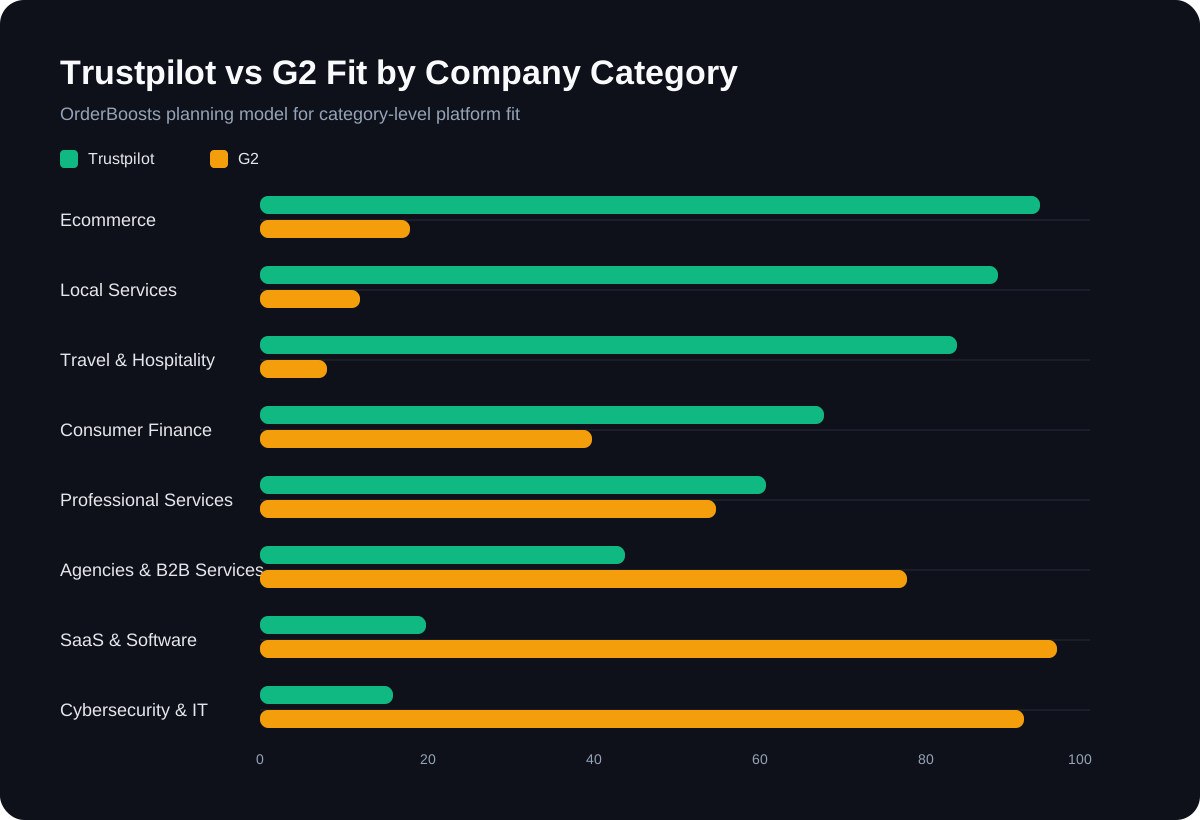
This chart is an OrderBoosts planning model, not a claim that every category follows one public industry census. The useful read is directional: consumer and local categories lean Trustpilot, while software-heavy and comparison-led categories lean G2.
Trustpilot usually wins for ecommerce, DTC, and local service brands
Trustpilot is the better first platform when your customers are everyday consumers and your main trust problem is simple: people need proof that you are real, reliable, and worth the money.
That is why Trustpilot tends to fit:
- ecommerce stores
- DTC brands
- home services
- travel and hospitality
- local healthcare brands with strong consumer demand
- marketplaces and subscription products with high branded search volume
For these companies, Trustpilot can support branded search, post-purchase confidence, and website conversion. It also fits better when you need broad public review volume instead of highly technical product feedback.
G2 usually wins for SaaS and B2B software companies
If you sell software to teams, G2 is usually the better first bet.
That is because G2 sits closer to the actual software buying workflow. Buyers search categories. They compare alternatives. They read feature-level reviews. They care about company size, implementation complexity, integrations, and use case fit.
G2 tends to fit best for:
- SaaS companies
- B2B software vendors
- developer tools
- martech and sales tech
- cybersecurity vendors
- workflow and ops platforms
If your pipeline depends on category pages, alternative pages, buyer intent signals, and comparison intent, G2 is rarely optional.
Agencies and consultancies are the gray area
This is where teams get confused.
If you are a service business selling to consumers or small local clients, Trustpilot usually makes more sense. If you are a consultancy selling to RevOps, finance, HR, or procurement teams with software-like delivery, G2 can work surprisingly well.
The practical rule is this:
- If buyers search your brand to decide whether they trust you, lean Trustpilot.
- If buyers compare you inside a software or solutions shortlist, lean G2.
Some brands should use both, but not on day one
Using both platforms can be smart when:
- you sell to both consumers and businesses
- you have a SaaS product plus a service layer
- you already have review volume on one platform and want to expand coverage
- your brand SERP and category SERP are both commercially important
What you should not do is split your effort too early.
A weak Trustpilot profile plus a weak G2 profile does not beat one strong primary platform. Start where buyer intent is clearest. Add the second platform only when you can maintain review velocity, response quality, and profile completeness on the first.
Trustpilot vs G2 for SEO, visibility, and conversion
This is the part many articles get wrong. They treat SEO value like a generic domain authority contest.
It is not.
Trustpilot is better for branded trust SEO
Trustpilot helps most when the searcher already knows your name or is close to buying.
That can improve:
- branded click-through rate
- conversion confidence on high-intent brand searches
- trust perception on your homepage and product pages
- off-site proof when prospects look you up after seeing an ad or social mention
Trustpilot can also support richer review content across your site if you use product or service review widgets. Trustpilot's business product pages emphasize this on features like product reviews.
For many consumer brands, that is enough. You do not need a category marketplace. You need proof.
G2 is better for comparison SEO and demand capture
G2 has a structural advantage in B2B software search because it naturally aligns with high-intent queries:
- best tools
- alternatives
- vs pages
- category leaders
- enterprise buyer research
If your buyers compare products before they book a demo, G2 can influence pipeline earlier and more directly than Trustpilot.
This is also where G2 becomes useful in AI search and answer surfaces. Large category and comparison pages get cited because they aggregate options, review patterns, and category language in a way that matches B2B research behavior.
Conversion quality matters more than traffic volume
A smaller amount of high-fit traffic beats a larger amount of low-fit traffic.
That is why G2 often produces better downstream value for software companies even if Trustpilot feels more recognizable. It is also why Trustpilot often outperforms G2 for ecommerce brands even if G2 looks more "professional" on paper.
The real question is not "Which platform ranks better?"
The real question is "Which platform shows up at the exact moment my buyer needs outside proof?"
Where Trustpilot and G2 Matter in the Buying Journey
Trustpilot is strongest in branded trust and consumer reassurance, while G2 does more work in discovery, alternatives, and shortlist evaluation.
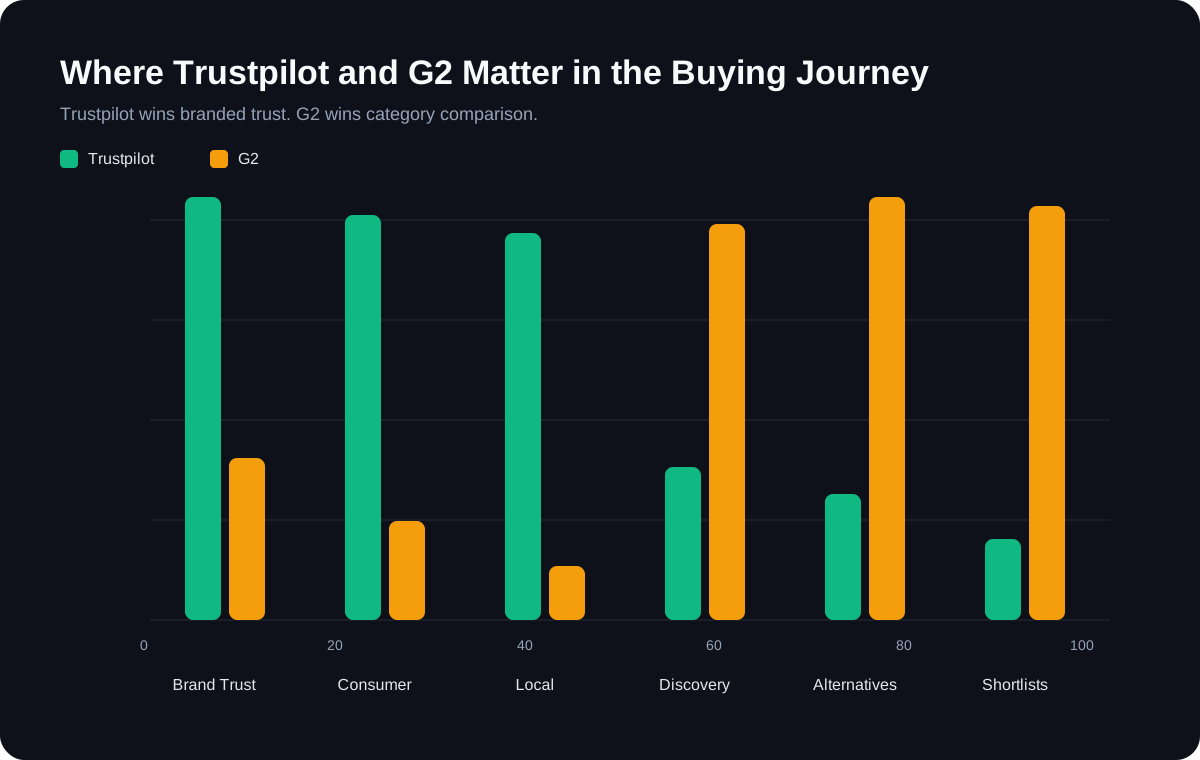
That second view explains why the category decision usually feels clearer once you map the buying moment. Trustpilot wins more trust-check moments. G2 wins more comparison-led moments.
Trustpilot vs G2 pricing in 2026
Pricing changes. That is why generic comparison posts age badly.
As of April 7, 2026, Trustpilot's public pricing page shows:
- Free
- Plus from $339 per month
- Premium from $699 per month
- Advanced from $1,229 per month
- Enterprise as custom pricing
As of April 7, 2026, G2's public plans page shows:
- Free
- Starter from $299 per month for eligible smaller teams
- Higher tiers through sales-led pricing
Do not stop the analysis there.
The hidden cost is operational, not just subscription
The real cost of either platform is the system behind it:
- how you request reviews
- how fast you respond
- how consistently you generate new proof
- how well your profile positioning matches your sales motion
This is why a cheaper plan can still become the more expensive choice if it attracts the wrong traffic or sits outside your buyer journey.
Pricing should be a tie-breaker, not the first filter
If you are a SaaS company, saving a few hundred dollars a month by skipping G2 can be a bad trade if it weakens category visibility and demo pipeline.
If you are a DTC brand, paying for G2 because it feels enterprise-ready can be just as wasteful if your buyers never use it.
Pick the platform that fits the buyer. Then optimize cost inside that lane.
How to choose the right platform in practice
Here is the clean decision framework we use.
1. Map the buyer
Ask one blunt question: who actually reads the reviews before the sale?
- consumers
- procurement teams
- software operators
- IT leaders
- local buyers
- ecommerce shoppers
If it is mostly consumers, start with Trustpilot. If it is mostly software evaluators, start with G2.
2. Map the buying moment
Review platforms support different moments:
- Trustpilot is stronger when the buyer wants reassurance.
- G2 is stronger when the buyer wants comparison.
That distinction matters more than industry labels.
3. Map realistic review velocity
A dead profile is a weak trust signal on either platform.
Before you commit, estimate whether you can generate reviews consistently from real customers. If you need help setting targets, use our Review Velocity Planner and benchmark against the patterns in our review benchmarks by industry.
4. Pick one primary platform and one support layer
Your primary platform is where you build review depth and ongoing velocity.
Your support layer might be:
- Google reviews for local trust
- Trustpilot for broad public proof
- G2 for B2B comparison intent
- case studies and testimonials on your site
This layered approach usually works better than trying to make one platform do every job.
Common mistakes in the Trustpilot vs G2 decision
The pattern is predictable.
Mistake 1: confusing review count with review quality
A large pile of reviews is not enough if they do not influence the right buying moment.
G2 often wins with fewer but more decision-relevant reviews. Trustpilot often wins with broader trust proof at scale.
Mistake 2: copying the same review workflow onto both platforms
The ask, timing, and use case should match the platform.
For Trustpilot, your workflow is often tied to purchase completion, delivery, or customer service resolution. For G2, the best review requests usually happen after onboarding success, measurable product adoption, or clear feature wins.
Mistake 3: ignoring recency and response behavior
Buyers do not just read your average score. They read the last few reviews. They look at how recent they are. They notice whether your team replies.
That is why recency, response rate, and profile completeness belong in your monthly review ops. Our guide to review health score metrics covers the exact signals worth tracking.
Mistake 4: choosing based on what competitors use without checking fit
Competitors can be wrong.
A consumer brand copying a SaaS review playbook wastes energy. A software company copying a retail trust playbook misses high-intent demand.
Study competitors, but do not outsource strategy to them.
Our recommendation if you are still unsure
If you sell software, choose G2 first.
If you sell to consumers, choose Trustpilot first.
If you are hybrid, choose the platform that matches your highest-value revenue motion first, then expand once you can sustain it.
That sounds almost too simple, but simple is usually right here.
You do not need a grand unified review strategy on day one. You need a review platform that supports the way your buyers actually make decisions.
Trustpilot vs G2 FAQ
Is Trustpilot or G2 better for SEO?
Neither platform is "better for SEO" in every situation. Trustpilot is usually better for branded trust and consumer reassurance. G2 is usually better for B2B category, alternatives, and comparison intent. Match the platform to the search behavior you want to influence.
Is G2 only useful for SaaS companies?
Mostly, but not only. G2 is strongest for software and tech-enabled B2B offers. Some agencies, consultancies, and managed service providers also benefit when buyers compare them in software-adjacent categories.
Should startups use both Trustpilot and G2?
Usually not at the beginning. Most startups should build one credible profile first. Add the second platform when you can support fresh review flow, profile optimization, and response management without stretching the team too thin.
Which platform is cheaper as of April 7, 2026?
On public entry pricing as of April 7, 2026, G2's Starter plan begins at $299 per month for eligible smaller teams, while Trustpilot's Plus plan begins at $339 per month. That does not mean G2 is always the cheaper total option because packaging, sales add-ons, and internal effort vary.
Can you copy reviews from Trustpilot to G2 or from G2 to Trustpilot?
No, not as a direct one-to-one move. These are separate platforms with separate review systems, rules, and buyer contexts. You can repurpose themes and learnings from one platform to improve messaging on the other, but not simply transfer reviews across.
What if I already have Google reviews?
That is good, but it does not replace either platform. Google reviews are strong for local trust and general reputation. Trustpilot adds broader public brand proof. G2 adds deeper B2B software comparison coverage.
If you are deciding what to do next, start by auditing where prospects already look for proof. Then build the platform mix around that behavior.
If you want a broader framework for that audit, read our online reputation management guide, our breakdown of the best Trustpilot alternatives, and our review of the best G2 review management tools.
OrderBoosts helps brands plan review velocity, platform fit, and reputation workflows without treating every review channel the same. If you need a second opinion on whether Trustpilot, G2, or a mixed strategy makes sense for your business, start with the platform that matches buyer intent and build from there.