Jump to a section
Cheap Trustpilot Reviews vs Quality Delivery: What U.S. Businesses Should Know
Searches for cheap Trustpilot reviews usually come from a real business problem: the profile looks thin, a competitor has more visible proof, or a few negative reviews are dragging conversion down. The temptation is obvious. If one provider says $5 to $10 per review and another charges $17 to $20, the cheaper option looks like easy savings.
The catch is that review cost is not just the posted price. The real cost includes removal risk, profile volatility, refund leverage, compliance exposure, and the time your team spends cleaning up a bad campaign.
This guide compares cheap review offers against quality-managed delivery so U.S. businesses can make a clearer decision before buying. It also covers related searches like buy Trustpilot reviews cheap, buy verified Trustpilot reviews, and buy Trustpilot reviews USA without turning the article into a duplicate of the service page. If you already know you want a managed package, compare the live Buy Trustpilot Reviews page. If you are still evaluating budget, use the full OrderBoosts pricing page first.
The Short Answer
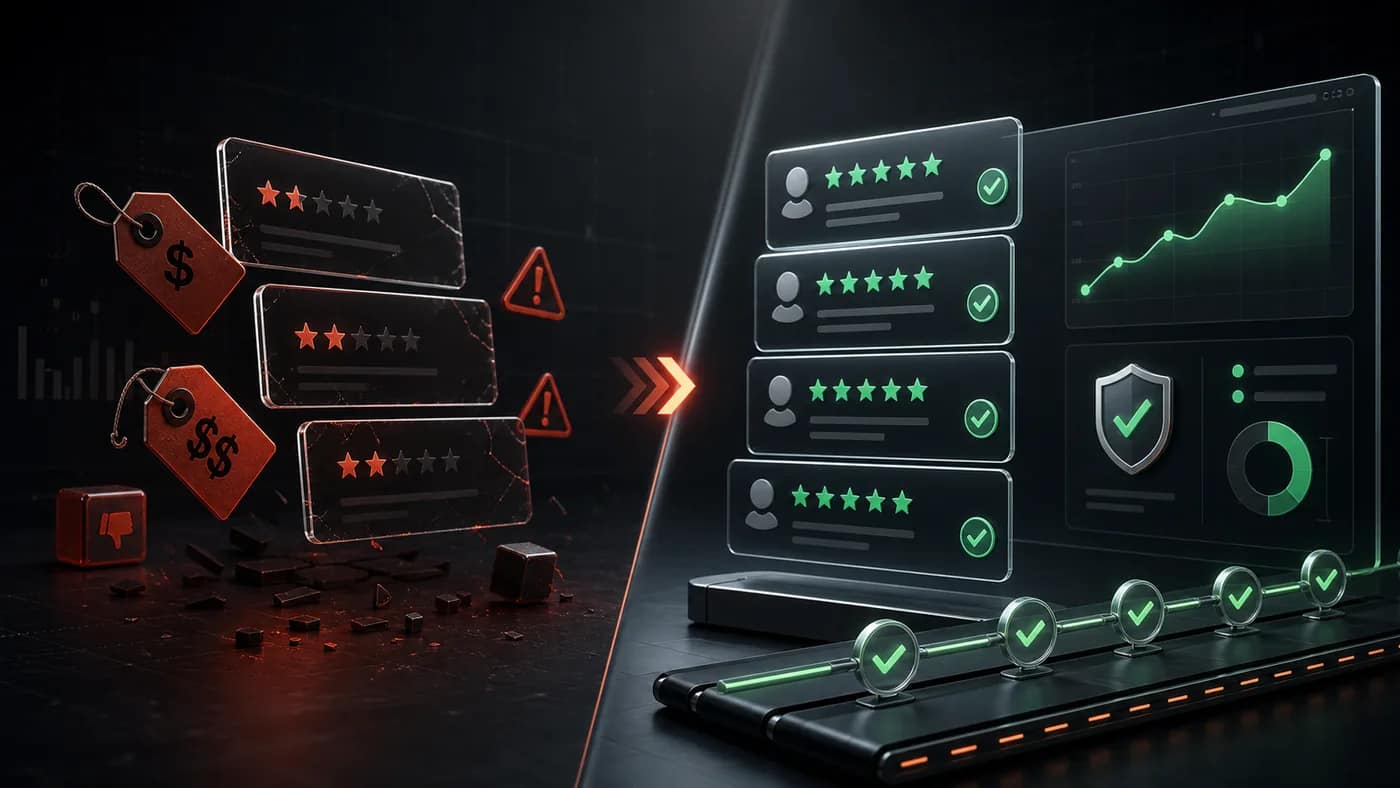
Cheap Trustpilot reviews can look attractive when you only compare unit price. Quality delivery costs more because the provider has to manage pacing, writing quality, account history, support, documentation, and replacement handling.
For most U.S. businesses, the practical question is not "what is the cheapest review?" It is:
- Will the reviews stay live long enough to matter?
- Will the campaign create suspicious velocity?
- Will the provider document scope and payment terms?
- Will the wording fit the business instead of reading like a template?
- Will the campaign create legal or platform risk the business cannot absorb?
If the answer is unclear, the lower price is not a discount. It is unpriced risk.
Why Cheap Trustpilot Review Offers Are So Tempting
Trustpilot profiles influence how buyers feel before they talk to sales, finish checkout, or request a quote. A stronger rating and fresher review feed can help a business look more established, especially when customers compare multiple vendors in the same category.
That pressure creates demand for fast, low-cost review offers. The common pitch is simple:
- instant or near-instant start,
- low per-review pricing,
- custom text,
- country targeting,
- "verified" or "real profile" claims,
- replacement promises if reviews disappear.
Some of those claims may be legitimate. Others are too vague to evaluate. A buyer should not treat a Trustpilot review service like a commodity unless the provider can explain delivery controls, acceptance rules, and what happens if reviews are removed.
Price Reality: What Cheap Usually Leaves Out
The public market for Trustpilot review services often shows a wide spread. Low-cost sellers may advertise prices around a few dollars per review. More managed services charge more because they include slower delivery, profile-quality controls, support, and replacement terms.
OrderBoosts currently positions Trustpilot packages around $17 to $20 per review depending on package size, with packages starting at $100. The point is not that every higher-priced provider is better. The point is that a credible provider should be able to explain why the price exists.
| Cost Factor | Cheap Offer Pattern | Quality Delivery Pattern |
|---|---|---|
| Delivery speed | Fast start, sometimes same-day volume | Drip-fed delivery over a realistic window |
| Writing quality | Reused or generic phrasing risk | Business-specific, varied wording |
| Profile quality | Vague "real user" claims | Clear standards for aged or activity-verified profiles |
| Documentation | Minimal checkout details | Written scope, cadence, support, and replacement rules |
| Payment control | Pay first, resolve later | Trial, milestone, PayPal, or pay-after-delivery options |
| Risk handling | Short or unclear warranty | Defined replacement window and escalation path |
For buyers who want tighter payment controls, compare Buy Trustpilot Reviews with PayPal. If upfront cash risk is the main blocker, review the pay-after-delivery Trustpilot review model.
Red Flags When Comparing Cheap Trustpilot Reviews
Price alone is not the red flag. The problem is price plus weak operating detail.
Instant Delivery Promises
Fast delivery is appealing, but sudden review bursts are easy to question. A profile that receives little activity for months and then gets a sharp cluster of glowing reviews can look unnatural to buyers and platforms.
A stronger provider should be able to explain weekly pacing, not just speed.
No Written Scope
If the offer does not define quantity, timing, refund terms, replacement terms, support contact, and acceptance criteria, the buyer has little leverage. This matters even more for U.S. teams that need a clean internal record for finance, compliance, or legal review.
Vague "Verified" Claims
"Verified Trustpilot reviews" is one of the most abused phrases in this market. Trustpilot's own business guidance says reviewers must have had a recent, genuine experience, and its invitation process needs to be fair and neutral. Before paying for any verified-review claim, read the Trustpilot verified reviews buyer checklist.
This is especially important when a vendor ranks for or advertises around buy verified Trustpilot reviews. The phrase is commercially useful, but the buyer still needs to confirm what "verified" means in practice.
Recycled Profile Risk
Low-cost providers may rely on repeated account pools, thin profiles, or similar posting patterns. Even if the review text looks different, the surrounding behavior can still create risk.
You do not need to know the provider's full backend process, but you should ask what controls prevent repeated patterns.
No Replacement Logic
Every review campaign has uncertainty. If a provider says removals are impossible, that is not a serious risk model. A better answer defines the replacement window, what counts as a covered drop, and what evidence the buyer needs to provide.
Pressure to Skip Documentation
If a seller wants payment through hard-to-dispute channels and avoids written terms, the low price is doing too much work. A serious provider should not object to a simple written order summary.
What Quality Delivery Should Include
A managed Trustpilot review service should be judged by the controls around delivery, not only by the final star count.
Use this checklist before buying:
| Control | What to Look For | Why It Matters |
|---|---|---|
| Cadence plan | Daily or weekly pacing instead of a sudden dump | Reduces profile volatility and buyer suspicion |
| Written scope | Quantity, timing, support terms, and replacement rules | Prevents disputes and vague expectations |
| Review quality standard | Realistic, varied, business-specific wording | Keeps the profile believable to customers |
| Geography alignment | Reviews that match your actual customer markets | Avoids credibility gaps in U.S. or local campaigns |
| Payment protection | PayPal, milestone, first-review test, or pay-after-delivery terms | Reduces cash risk before trust is proven |
| Replacement window | Clear policy for covered drops | Gives the buyer a practical remedy |
| Internal documentation | Order summary, delivery logs, support records | Helps with finance, compliance, and post-campaign review |
This is why OrderBoosts points buyers toward planning before volume. The TrustScore calculator helps estimate how much review volume is needed, and the review velocity planner helps translate that target into a steadier cadence.
U.S. Compliance: The Risk Is Not Abstract
U.S. businesses should treat review buying as a legal and operational decision, not only an SEO tactic.
The FTC's Consumer Reviews and Testimonials Rule Q&A explains that the rule addresses deceptive conduct involving consumer reviews and testimonials. It also states that review brokers and reputation management companies can face liability if they create or sell fake or false consumer reviews.
That matters for buyers because "cheap" campaigns are often light on documentation. If a campaign uses false experience claims, insider reviews, misleading testimonials, or compensation conditioned on a specific sentiment, the business may inherit risk even if a third-party vendor did the work.
Trustpilot's own policies add another layer. Its Guidelines for Businesses say people who review a business should have had a recent, genuine experience, and that invitations should be fair and neutral. The same guidance says businesses should not ask people to write fake reviews.
Trustpilot's Action We Take policy also describes platform actions for misuse, including consumer warnings, limiting search-engine data sharing in some warning situations, and possible legal action depending on severity.
The practical takeaway: do not buy blind. A provider's price should be evaluated alongside the campaign's evidence trail and policy exposure.
Cheap Vendor vs Managed Provider vs DIY Invitations
Not every business needs the same path. The right choice depends on urgency, budget, risk tolerance, and whether you already have a reliable customer invitation engine.
| Option | Best For | Strength | Weakness |
|---|---|---|---|
| Cheap vendor | Very small test budgets with high risk tolerance | Low upfront unit price | Weak documentation, higher volatility, unclear remediation |
| Managed provider | Brands that need faster trust signals with support | Better pacing, support, replacement process, and payment controls | Higher per-review price |
| DIY invitations | Businesses with steady customer volume and strong operations | Lowest policy risk and strongest long-term authenticity | Slowest path when the profile needs urgent movement |
If your current profile has a few reviews, no recent activity, and a conversion problem, a managed pilot may be more sensible than chasing the cheapest possible review. If you have hundreds of happy customers and a working CRM, DIY invitations may be enough.
When Paying More Is Worth It
A higher-priced Trustpilot review service is easier to justify when:
- paid traffic is already losing conversions because the Trustpilot profile looks weak,
- a negative review cluster is hurting branded search confidence,
- the business needs U.S. or market-aligned review signals,
- finance or leadership needs a written scope before approving spend,
- the team wants PayPal, pay-after-delivery, or first-review testing,
- review loss would create more cost than the price difference saved.
In those cases, the premium is not just for review text. It is for controlled execution and a cleaner fallback plan if something goes wrong.
When You Should Not Buy Yet
Delay any paid Trustpilot campaign if:
- your product or service is currently causing repeat complaints,
- you cannot respond professionally to new negative reviews,
- there is no owner for monitoring delivery and profile health,
- you do not know your current review count, rating, or target TrustScore,
- the provider cannot explain payment, delivery, and replacement terms.
Fixing operational issues first is usually cheaper than buying review volume to cover them. Use Trustpilot review removal process if the issue is policy-violating negative content, and use best Trustpilot invitation email templates if the bigger issue is weak organic collection.
For a non-paid improvement path, the LeetCode article 7 Proven Ways to Improve Your Trustpilot Score is a useful companion because it focuses on invitation timing, response discipline, pacing, and profile completion instead of bulk buying.
Buyer Questions to Ask Before Paying
Ask these before choosing any Trustpilot review provider:
- What is the delivery window for the package?
- Is there a written replacement policy?
- What happens if reviews drop inside the guarantee period?
- Can I test one review before scaling?
- Can I use PayPal or pay after delivery?
- How do you avoid identical wording and suspicious timing?
- Can the campaign match my main customer geography?
- What records will I receive after delivery?
If a seller cannot answer these clearly, the cheap price should not be treated as a reliable quote.
Recommended Path for U.S. Buyers
Use a three-step decision model:
- Model the need. Use the TrustScore calculator to estimate how many reviews are actually needed.
- Control payment risk. Compare PayPal payment controls and pay-after-delivery terms.
- Start small. Use a first-review test or small package before scaling volume.
That path protects budget while still giving the business a realistic way to move faster than organic invitations alone.
If you are comparing review management tools before choosing whether to buy, the HackMD roundup 7 Best Reputation Management Platforms in 2026 gives broader context on OrderBoosts, Trustpilot Business, Birdeye, Podium, Reputation.com, Yotpo, and ReviewTrackers.
FAQ
Are cheap Trustpilot reviews safe?
They can be risky if the provider uses instant delivery, generic text, weak account quality, or unclear replacement terms. Safety depends less on the advertised price and more on pacing, documentation, review quality, and policy exposure.
What does a Trustpilot review service cost?
Prices vary widely. Some low-cost sellers advertise very cheap unit pricing, while managed services charge more for pacing, support, replacement handling, and payment controls. OrderBoosts Trustpilot packages currently range from $20 per review on a starter package down to $17 per review at larger package sizes.
Is it safe to buy Trustpilot reviews in the USA?
There is no universal yes or no. U.S. businesses need to consider FTC rules, Trustpilot guidelines, and the exact execution model. Avoid false experience claims, vague vendor terms, and campaigns that create obvious profile volatility.
What is better: cheap reviews or verified Trustpilot reviews?
"Verified" only matters if the claim is real and understood. Do not pay extra for the word alone. Check what the provider can actually control, then compare it with the Trustpilot verified reviews buyer checklist.
Should I buy Trustpilot reviews cheap or use invitations?
Use invitations if you have enough happy customers and time. Consider a managed campaign if organic collection is too slow and the profile is hurting conversion. Avoid cheap vendors that cannot document delivery and replacement terms.
Bottom Line
Cheap Trustpilot reviews are only cheap if they stay live, look credible, and do not create cleanup work. For U.S. businesses, the smarter comparison is total risk-adjusted cost: review quality, pacing, support, documentation, and payment protection.
If you want to compare a controlled campaign, start with the current Buy Trustpilot Reviews packages. If you are still budgeting across platforms, review OrderBoosts pricing before choosing volume.