
Jump to a section
Introduction
TL;DR
A framework for identifying, fighting, and preventing fake reviews to protect your revenue and brand reputation across all major reviewing platforms.
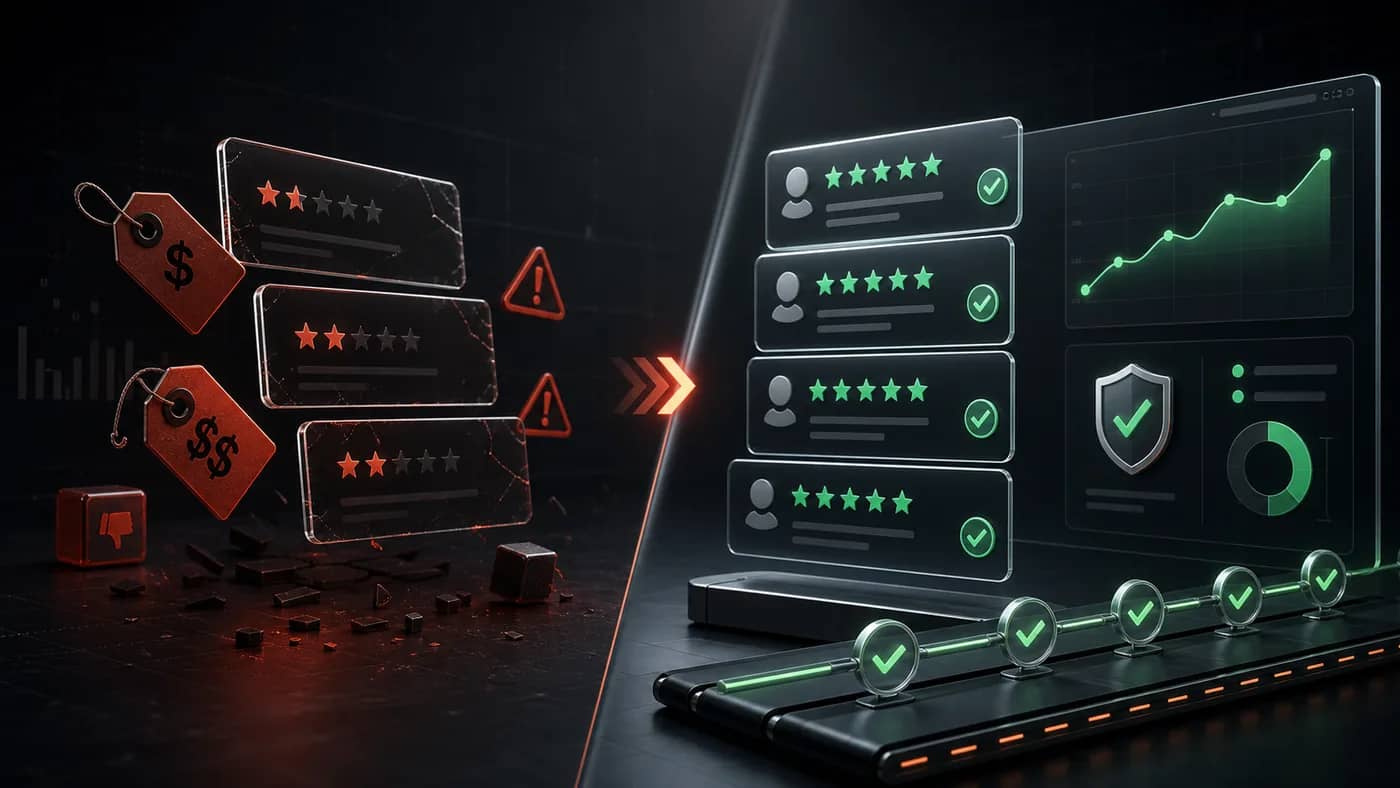
Fake reviews distort buyer perception and can trigger platform penalties. Whether you operate on G2, Trustpilot, or Google, knowing how to identify, respond to, and prevent fake feedback is essential for protecting revenue and reputation. The problem is larger than most businesses realize: an estimated 4–12% of reviews across major platforms are fraudulent, and coordinated attack campaigns — where competitors flood a profile with 1-star reviews — can collapse months of reputation-building in days. When fake feedback is already live, combine this playbook with our negative review response guide and the Trustpilot removal workflow for escalation coverage.
Risks and Signals
The first step is knowing what anomalous review activity looks like so you can catch it quickly. Generic advice to "look for suspicious patterns" is not enough — you need specific signals to monitor.
Volume anomalies: A sudden spike of 15–20 reviews within 48 hours is a red flag, especially if your normal velocity is 2–3 reviews per week. Real customer review patterns follow usage curves — they do not spike randomly.
Rating distribution collapse: If your average drops from 4.3 to 3.6 over a weekend, something external happened. Genuine product quality issues produce gradual rating declines correlated with specific releases or incidents — not sudden overnight drops.
Content similarity: Multiple reviews using the same unusual phrasing, complaining about the exact same obscure feature, or structured identically (three sentences, specific words) suggest a coordinated campaign. Real users write organically and inconsistently.
Account characteristics: Reviewer accounts created within the past 30 days, with no review history except your listing, are high-risk signals. Cross-reference account age with review timing on platforms that expose this data.
Geographic impossibility: Reviews from locations where your product is not available, from users claiming experiences that cannot have happened (reviewing a SaaS tool as if it were a physical product), or from markets outside your customer base are easy to flag for removal.
Detection Framework
Manual spot-checking is not enough at scale. A systematic detection process requires three layers:
- Baseline establishment: Define your normal review cadence — average reviews per week, typical rating distribution, geographic spread of reviewers. You cannot identify an anomaly without knowing your baseline.
- Automated monitoring: Set up weekly alerts for review spikes (any day with more than 2x your average daily review count). Use platform tools where available — Trustpilot's Transparency Reports flag suspected fraud; G2 has native moderation systems; Google Business Profile offers reporting workflows for policy violations. AI-assisted triage can help here; see how to use AI in review management without over-automation.
- Risk scoring and escalation: When an anomaly is detected, apply a risk score based on: account age (new = high risk), review timing (overnight cluster = high risk), content similarity (repeated phrases = high risk). Reviews scoring high on two or more factors go to manual review immediately. Do not wait for platform moderators to catch what you can see clearly.
Platform-specific reporting processes differ significantly. On Google, use the "Flag as inappropriate" workflow with detailed violation notes. On Trustpilot, use the Business Portal reporting function and cite the specific guideline violated. On G2, contact their fraud team directly with a detailed description and supporting account data. The more specific your report, the higher the removal success rate.

Response Playbook
When you identify a suspected fake review that has not yet been removed, your public response matters. Future buyers will read it, and how you handle it shapes their perception of your brand's credibility.
Respond calmly and professionally without being accusatory. A response like "We have no record of a customer with this experience — we'd welcome the chance to verify the details if you contact us at [support email]" accomplishes three things: it signals to legitimate readers that the review may be fraudulent, it creates a documented request for verification, and it shows that you engage professionally with all feedback.
If the review includes specific claims about your product or service that are factually incorrect, address them briefly with accurate information. Do not write a lengthy rebuttal — keep it to two to three sentences. The goal is to neutralize the review's impact, not to escalate a public argument.
Never use defensive language, accusatory phrasing, or emotional responses. Any hostility in your reply reflects worse on your brand than the fake review itself.
Prevention Tactics
The most powerful defense against fake reviews is a review base so large and so recent that any manipulation attempt is diluted before it can meaningfully impact your rating. A profile with 500 reviews averaging 4.6 stars absorbs a 20-review attack without moving more than a decimal point. A profile with 30 reviews is devastated by the same attack.
- Maintain a consistent authentic review pipeline. Encourage regular feedback from verified customers through post-purchase emails, in-product prompts, and customer success touchpoints. For local brands, this directly strengthens visibility signals covered in Local SEO and Google Reviews in 2026.
- Use verified-purchase or domain-based validation. On platforms that offer it, ensure your reviews are gated behind verified purchase or account authentication. This raises the cost for attackers who would otherwise create throwaway accounts.
- Educate customers on official review links. Share direct links to your review profiles, not generic search links. This reduces the risk of customers accidentally reviewing a spoofed or duplicate listing.
- Monitor third-party listings and brand mentions. Set up Google Alerts and social listening for your brand name. Impersonation attempts — fake listings using your business name — are a growing attack vector that can be addressed before they accumulate reviews.
- Document your customer relationships. Maintain records of customer interactions, purchases, and support tickets. When you report a fake review, having the ability to state "we have no record of any customer with this profile" is a powerful escalation tool.
Conclusion
Combating fake reviews requires consistent monitoring, clear escalation rules, and a proactive pipeline of real customer feedback. By pairing automation with human oversight, you can keep ratings accurate and preserve buyer trust. The businesses that win the long-term reputation game are those that treat their authentic review programs with the same operational rigor they apply to product development or customer success — systematic, measured, and continuously improved. For a full operating model, follow this online reputation management guide.