Jump to a section
The Law of Trust: Why 4.6 Stars Can Outperform a Perfect 5.0
You have probably seen the meme: a business with 5.0 stars from 19 reviews feels less convincing than one with 4.6 stars from 2,280 reviews. That reaction is not irrational. It is how real buyers process risk in a few seconds.
For most businesses, trust is not built by looking perfect. It is built by looking proven at scale. If you are trying to improve conversion with social proof, this is the rule that matters most.
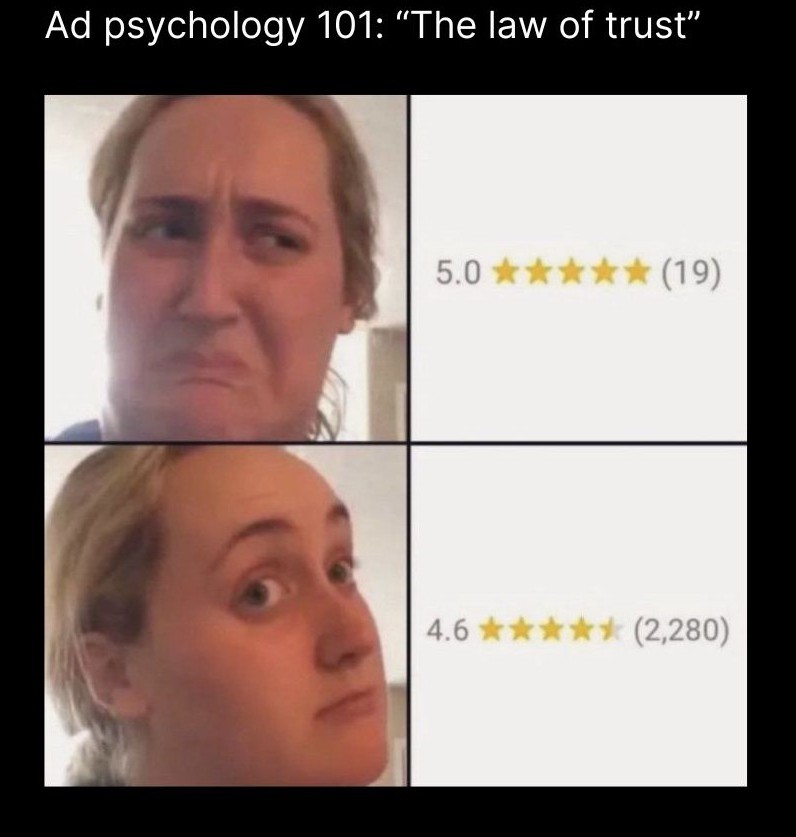
Trust signal in practice: credibility beats perfection when volume is visible.
Why a perfect 5.0 with low volume can reduce trust
A flawless score sounds strong, but buyers immediately ask:
- Is this sample too small to trust?
- Were only happy customers asked to review?
- Is this profile too curated to be real?
In other words, a tiny perfect score creates uncertainty. Buyers do not only judge quality. They judge whether the signal feels representative of what will happen to them.
Why 4.6 with high volume often converts better
A 4.6 across thousands of reviews communicates three things quickly:
- Lots of people bought from this brand
- Most people had a good experience
- A normal number of imperfect outcomes exist
That pattern feels authentic, and authenticity lowers purchase anxiety. This is exactly why brands investing in consistent reputation growth often outperform those chasing a cosmetic perfect score.
If your Trustpilot profile is still thin, start with a structured growth plan through our Trustpilot review service.
What buyers scan first before they decide
Most visitors never read every review. They scan signals:
- Total review count
- How recent reviews are
- How the business responds to criticism
- Whether reviews include specific details or generic claims
This means trust is shaped by context, not by star rating alone. You can also model outcomes using our TrustScore calculator to estimate how additional review volume changes perceived credibility.
A practical trust formula for 2026
Use this operating principle:
- Prioritize consistency over one-time spikes
- Build review volume gradually and naturally
- Respond publicly to both positive and negative reviews
- Optimize for believable sentiment, not visual perfection
Your goal is not to look flawless. Your goal is to make a new buyer feel confident that their outcome will be predictably good.
What brands should do next
If your profile is high-rated but low-volume, your next move is clear: increase trusted volume and freshness. If your profile is high-volume but inconsistent, tighten operations and response quality so future reviews reinforce the same outcome story.
The best-performing brands treat review management as an ongoing conversion system, not a one-time campaign. If Trustpilot is not the right platform for your business, see our roundup of the best Trustpilot alternatives to find a better fit.
Conclusion + CTA
The meme gets one thing exactly right: buyers trust realistic proof at scale more than perfect numbers in a small sample.
If you want a trust profile that converts, focus on credibility patterns your customers can verify at a glance. Explore our Trustpilot review packages and build a stronger reputation signal with the right volume strategy.
For related reading, see How Trustpilot TrustScore is Calculated (2026 Formula Explained) and Trustpilot Score Calculator: Predict Your Rating Before Reviews.